
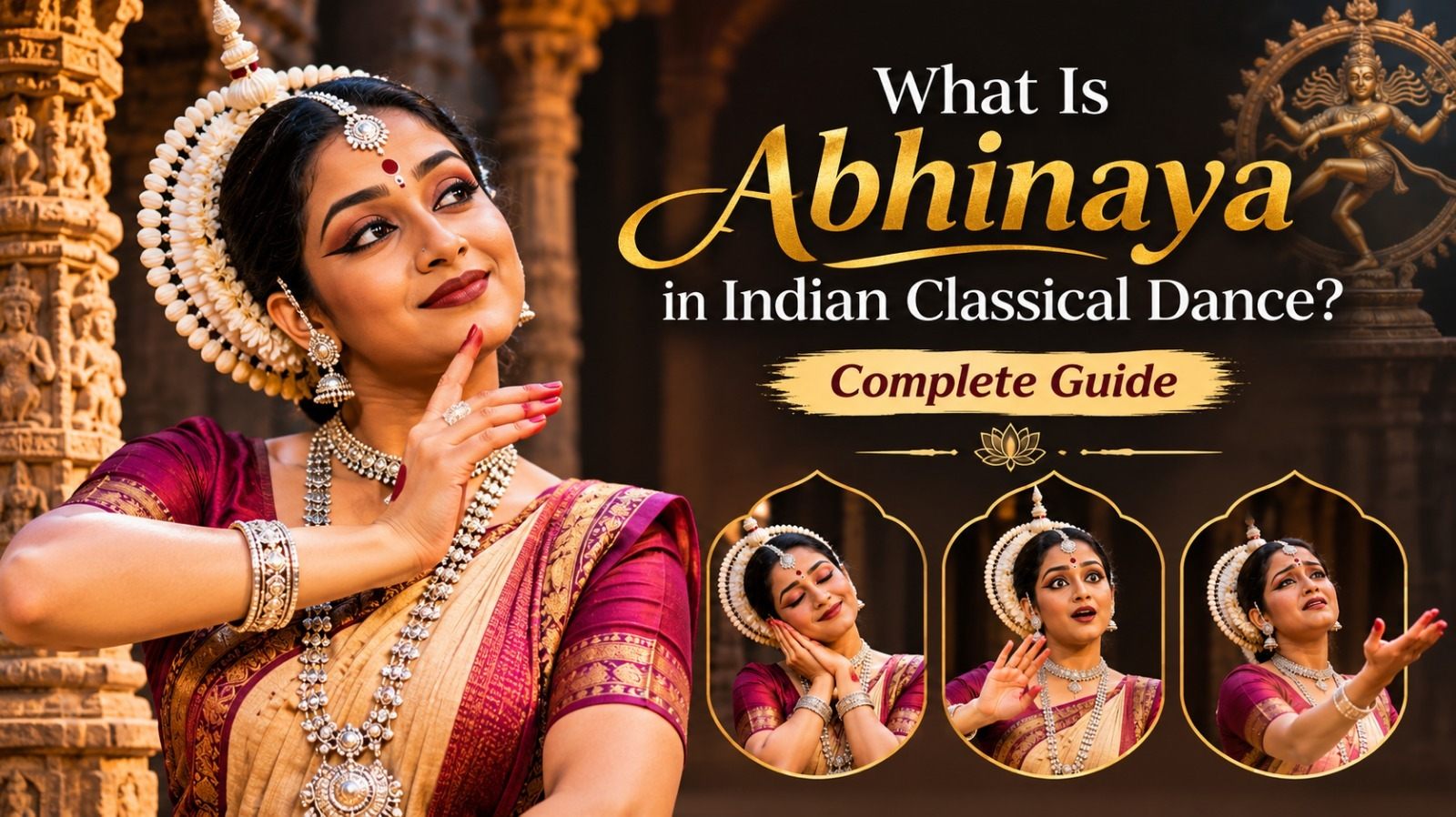
Quick Answer: Abhinaya in Indian classical dance means expression. It is how a dancer tells a story and shows emotion. The Natyashastra lists four types: Angika (body), Vachika (words and music), Aharya (costume) and Sattvika (inner feeling).
Abhinaya is one of the most important parts of Indian classical dance. The word abhinaya means expression or communication.
Through abhinaya, a dancer tells a story, shows emotions, and communicates meaning to the audience. Indian classical dance is not only about steps and rhythm. It is also about expression.
A dancer can show a flower, a river, a bird, a mother, a devotee, a god, or a heroine without using ordinary speech. This is possible because of abhinaya.
Abhinaya helps the audience understand what the dancer is trying to express.
Abhinaya in the Natyashastra
The Natyashastra, the ancient Indian text on dance, drama and music, explains abhinaya as an important part of performance.
According to the Natyashastra, abhinaya can be understood through four main types:
- Angika Abhinaya
- Vachika Abhinaya
- Aharya Abhinaya
- Sattvika Abhinaya
Each type plays an important role in Indian classical dance forms such as Odissi, Bharatanatyam, Kathak, Kuchipudi and others.
1. Angika Abhinaya
Angika abhinaya means expression through the body.
This includes the use of:
- Hands
- Eyes
- Eyebrows
- Neck
- Head
- Torso
- Feet
- Full body movement
For example, a dancer may use the hands to show a lotus, the eyes to show surprise, and the body to show the movement of a river.
In Odissi dance, angika abhinaya is very important. The graceful body movements, the use of the torso, and the sculptural postures help create meaning and beauty.
2. Vachika Abhinaya
Vachika abhinaya means expression through words, song, speech or sound.
In many classical dance performances, the dancer may not speak directly. But the song, lyrics and music help tell the story.
The singer, the poetry and the rhythm support the dancer’s expression.
For example, in Odissi dance, many abhinaya pieces are based on poetry and devotional songs. The dancer expresses the meaning of the song through the face, eyes, hands and body.
3. Aharya Abhinaya
Aharya abhinaya means expression through costume, jewellery, makeup and stage appearance.
These visual elements help the audience understand the character, mood and setting of the performance.
Aharya includes:
- Costume
- Jewellery
- Makeup
- Hairstyle
- Props
- Stage decoration
In Odissi, the saree, silver jewellery, headpiece and eye makeup are all part of aharya abhinaya. They are not only decorative. They help create the complete visual identity of the dancer.
4. Sattvika Abhinaya
Sattvika abhinaya means expression that comes from an inner emotional state.
It is not only about making an expression from outside. It refers to natural physical responses that arise when an emotion is deeply felt.
The eight sattvika bhavas are:
- Stambha – becoming still or motionless
- Sveda – sweating
- Romanch – goosebumps
- Svarabheda – change or break in the voice
- Vepathu – trembling
- Vaivarnya – change of colour or paleness
- Ashru – tears
- Pralaya – fainting or loss of consciousness
In dance, these are not always shown literally. A dancer suggests them with control and sensitivity.
For example, a character may show tears, stillness or trembling in a moment of devotion, fear, love or separation.
Why Is Abhinaya Important?
Abhinaya is important because it gives meaning to dance.
Without abhinaya, dance may remain only movement. With abhinaya, the dancer can tell a story and create emotion.
It helps the dancer show:
- Characters
- Emotions
- Situations
- Devotion
- Mythological stories
- Human feelings
This is why abhinaya is central to Indian classical dance.
Abhinaya in Odissi Dance
In Odissi dance, abhinaya has a very special place.
Odissi often uses poetry based on devotion, mythology, and the love of Radha and Krishna. The dancer uses facial expressions, hand gestures, eye movements and body movements to bring the poetry alive.
Odissi abhinaya is known for its subtlety and grace. The expressions are not always loud or dramatic. Many times, they are gentle, controlled and deeply emotional.
Abhinaya Turns Movement into Meaning
Abhinaya is the art of expression in Indian classical dance. It allows the dancer to communicate stories, emotions and ideas to the audience.
The four types of abhinaya are Angika, Vachika, Aharya and Sattvika.
Together, they make dance complete. Angika uses the body, Vachika uses words and music, Aharya uses costume and appearance, and Sattvika uses inner emotion.
Abhinaya is what turns movement into meaning and performance into experience.
You can learn all four types of abhinaya step by step. Join our online Odissi classes or train with us in Koregaon Park, Pune.
Frequently Asked Questions
What is abhinaya in Indian classical dance?
Abhinaya means expression or communication. It is the way a dancer tells a story and shows emotion through the body, face, gestures, music and inner feeling.
What are the four types of abhinaya?
The four types of abhinaya are Angika, Vachika, Aharya and Sattvika.
Why is abhinaya important in Odissi dance?
Abhinaya is important in Odissi dance because Odissi uses poetry, music, facial expressions, hand gestures and graceful body movement to tell stories and create emotion.
What is Angika abhinaya?
Angika abhinaya is expression through the body, such as the hands, eyes, head, torso and feet.

Leave a Comment Cancel reply