
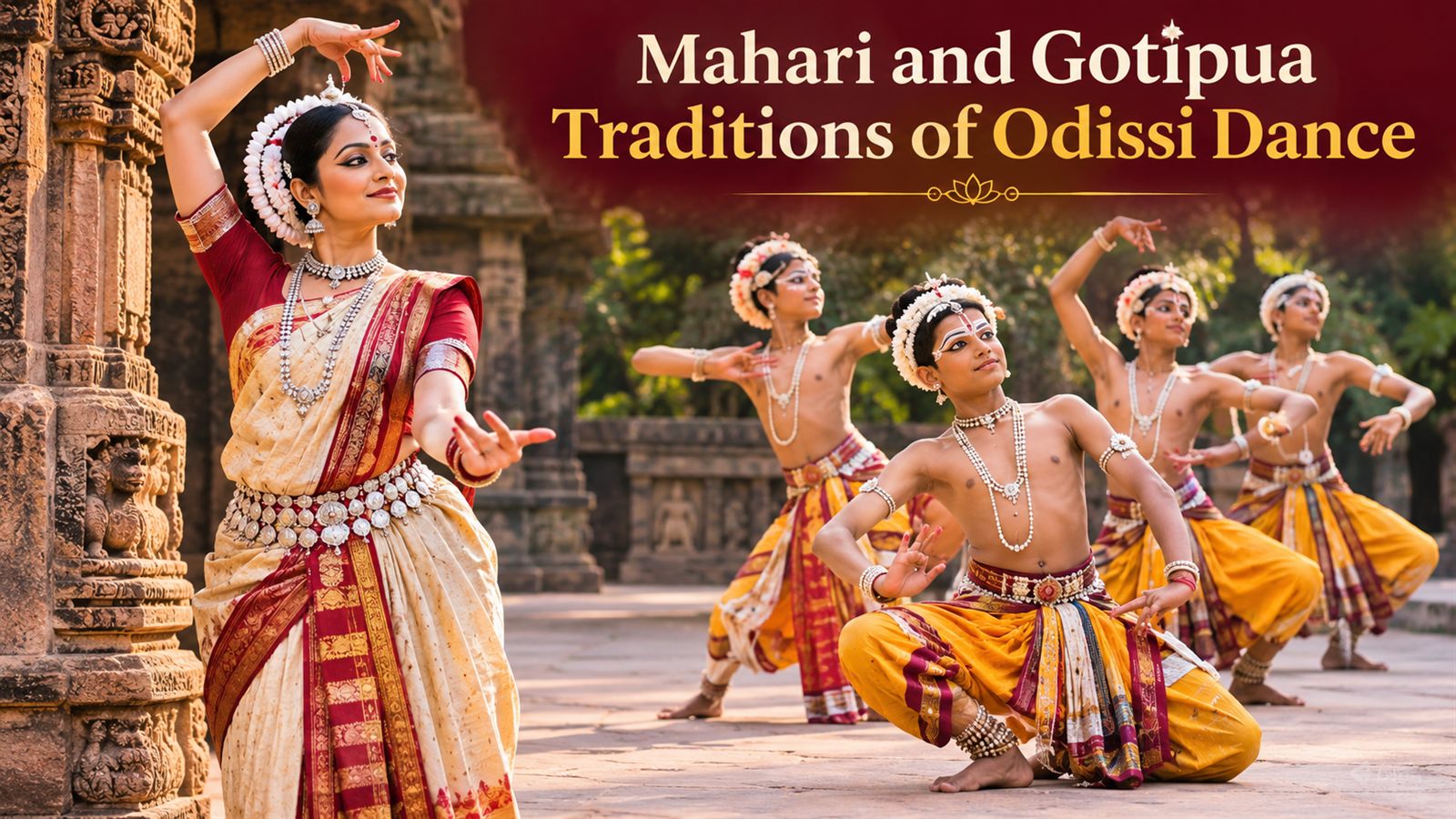
Quick Answer: The Mahari and Gotipua traditions kept Odissi alive. Maharis were women temple dancers devoted to Lord Jagannath. Gotipuas were young boys who danced dressed as women outside the temple, and carried the dance forward when temple traditions declined.
The history of Odissi dance cannot be understood without looking at the Mahari and Gotipua traditions. These two traditions played a very important role in preserving Odissi and carrying it from temple rituals to public performance spaces.
Odissi has its roots in the temple traditions of Odisha. It was originally connected with worship and devotion, especially to Lord Jagannath. Dance was not seen only as entertainment. It was a sacred offering, a way of connecting the human with the divine.
The Mahari Tradition
The Mahari tradition was central to the temple heritage of Odissi. Maharis were temple dancers dedicated to Lord Jagannath. The word Mahari is often understood as coming from Maha Nari, meaning great woman.
The Maharis performed during daily rituals and festivals in the temple. Their dance was an offering to the deity. It was deeply devotional and closely connected with bhakti. In this tradition, the dancer was not performing merely for an audience, but as part of a sacred ritual.
The Maharis often performed verses from the Geet Govind, the 12th-century Sanskrit text composed by Jayadeva. This text celebrates the divine love of Radha and Krishna and became very important in the expressive tradition of Odissi.
Mahari and Abhinaya
The Mahari tradition placed great importance on abhinaya, or expression. Since many of the compositions were devotional and poetic, the dancer had to communicate emotion through the face, eyes, hands and body.
This emphasis on expression continues to be one of the most beautiful aspects of Odissi dance today. Odissi abhinaya is known for its subtlety, grace and emotional depth. The Mahari tradition helped preserve this devotional and expressive quality of the form.
The Decline of the Temple Tradition
Over time, the temple traditions of dance began to decline because of social and political changes. Foreign invasions, changing systems of patronage and later colonial attitudes affected the position of temple dancers. The sacred role of the Maharis gradually weakened, and the classical form of Odissi began to lose its earlier institutional support.
However, Odissi did not disappear. Even when the Mahari tradition declined, important elements of the dance survived in other forms. One of the most significant among these was the Gotipua tradition.
The Gotipua Tradition
Gotipua literally means one boy. In this tradition, young boys dressed as women and performed dance outside the temple space. They carried forward many elements of the older Odissi tradition and helped keep the dance alive in public and devotional settings.
The Gotipua tradition included graceful movements, abhinaya, rhythmic patterns and more acrobatic elements. These performances were often seen in festivals, religious gatherings and public spaces. In this way, Gotipua became an important bridge between the older temple tradition and modern Odissi.
Gotipua and Modern Odissi
The Gotipua tradition had a strong influence on the technical aspects of modern Odissi. Many elements of movement, rhythm and physical training were preserved through this tradition. Some of the great gurus who helped revive and shape modern Odissi were connected with, or influenced by, the Gotipua tradition.
When Odissi was reconstructed and codified in the 20th century, scholars and gurus looked at several sources, including temple sculptures, Mahari traditions, Gotipua practices and ancient texts. This helped Odissi regain its classical identity.
Difference Between Mahari and Gotipua
The Mahari tradition was connected mainly with female temple dancers and ritual worship inside the temple tradition. The Gotipua tradition was carried by young boys dressed as women, performing outside the temple space.
Mahari preserved the devotional and expressive aspect of Odissi, especially through abhinaya and Geet Govind. Gotipua helped preserve the dance during a time when the temple tradition was declining, and added strength, rhythm and physicality to the evolving form.
Both traditions are important. One cannot understand Odissi dance fully by looking at only one of them.
Why Are Mahari and Gotipua Important?
Mahari and Gotipua traditions are important because they show how Odissi survived across changing times. They connect Odissi to Lord Jagannath, temple rituals, Geet Govind, abhinaya, rhythm, devotion and the later revival of the form.
They also remind us that Odissi is a living tradition. It was not created suddenly on the modern stage. It grew through temple worship, devotional performance, public practice, preservation and revival.
The Journey of Odissi from Temple to Stage
The Mahari and Gotipua traditions are central to the history of Odissi dance. The Maharis kept the dance connected to temple worship, Lord Jagannath and devotional abhinaya. The Gotipuas helped preserve the dance when temple traditions declined and carried many elements into public performance.
Together, these traditions shaped the journey of Odissi from the temple to the modern stage.
Odissi today carries the grace of the Maharis and the strength of the Gotipuas. Learn this living tradition in our online Odissi classes.
Frequently Asked Questions
Who were the Maharis in Odissi dance?
Maharis were temple dancers dedicated to Lord Jagannath. They performed dance as a devotional offering during temple rituals and festivals.
What is the Gotipua tradition?
Gotipua is a tradition in which young boys dressed as women performed devotional dance and helped preserve Odissi outside the temple space.
Why are Mahari and Gotipua important in Odissi?
They are important because they preserved the devotional, expressive and technical heritage of Odissi dance.
What does Mahari mean?
The word Mahari is often understood to come from Maha Nari, which means great woman.

Leave a Comment Cancel reply